Exoteric and esoteric
Every major religion has two sides. The exoteric side is the outer one: the institution, the rules, the buildings, the creeds, who's in and who's out. The esoteric side is the inner one: the mystics, the contemplatives, the people who went looking for God in their own hearts and came back with poetry instead of rules.
The outer path. God is out there. Scripture, clergy, ritual, belief, belonging. Very different from one religion to the next.
The inner path. God is in here. Prayer, stillness, direct experience. Across traditions, the lines start to blur.
The exoteric side isn't all bad. Community matters, and humans are tribal. But it can harden into control, and throughout history the people running religious institutions have often persecuted their own mystics.
To be fair to the other side of this debate: the scholar Stephen Prothero wrote a book called God Is Not One arguing that it's lazy to say the religions are all the same, and on the exoteric side he's right. Judaism centers on the commandments, Christianity on the cross, Islam on submission to God, Buddhism on the end of suffering, Hinduism on release from the cycle of rebirth. Those are real differences. The claim here is narrower. It's on the inner side, where people describe what they actually experienced, that the traditions start to sound like each other.
The blind men and the elephant
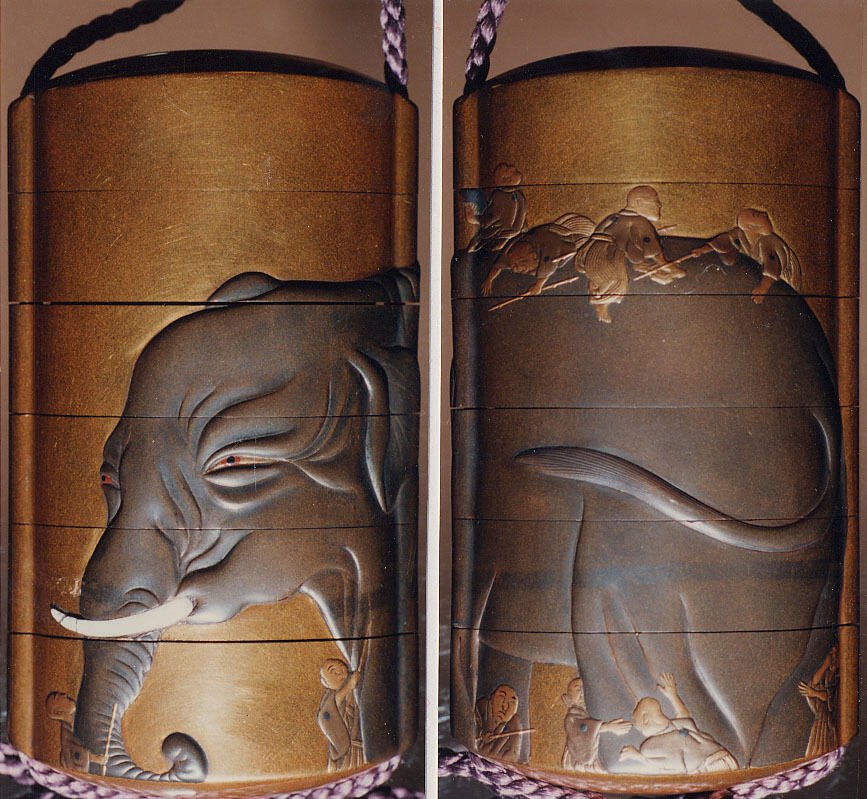
A group of blind men hear that a strange animal called an elephant has been brought to town. They go to find out what it is. The one who touches the trunk says it's like a thick snake. The one at the ear says it's a fan. The leg, a tree trunk. The side, a wall. The tail, a rope. The tusk, a spear. And they start to argue.
Then someone who can see walks by and says, it isn't like a snake, its trunk is like a snake. It isn't like a spear, its tusk is like a spear. Every one of you is right about the part you're touching, and wrong that it's the whole thing.
That's the argument between religions in one picture. Each tradition has its hands on something real. The fighting starts when one of them says its part is the whole animal.
The story is old and it travels. It's in the Buddhist scriptures, where the Buddha tells it about teachers quarreling over their views (Udāna 6.4). Jain teachers used it to show that truth has many sides. The Sufi poets Sanai and Rumi told it, Rumi's version with people feeling the elephant in a dark room. An American poet, John Godfrey Saxe, put it into English verse in the 1800s. And Ramakrishna loved it.
Ramakrishna
Ramakrishna was born Gadadhar Chattopadhyay in a tiny Bengali village in 1836 and spent most of his life as a priest at a Kali temple outside Calcutta. He fell into ecstatic trance so often that someone had to stand near him to catch him. He never wrote a book. Within a decade of his death in 1886, his teaching had reached Europe and America, mostly through his disciple Vivekananda.
What makes him matter here is what he did with his life. He didn't just say all paths lead to God. He tested it. After years as a devotee of the Divine Mother, he learned Tantra from a wandering nun, then Advaita Vedanta, the path of formless oneness, from a monk named Tota Puri. Then he practiced Islam for a time, and later Christianity. By his own account and his disciples', every one of them brought him to the same place.
God is one, but His aspects are many. As the master of a house is father to one, brother to another, and husband to a third, and is called by different names by different people, so the one God is described in various ways according to the particular aspects in which He appears to particular worshippers.
RamakrishnaHe had a homier way of saying it too. A mother brings home one fish and cooks it differently for each child: curry for one, fried for another, a mild soup for the one with a weak stomach. Different temperaments, different capacities, one fish. God made the different religions, he said, to suit different people.
One summit, a lot of trails
Call it the kingdom of heaven, liberation, Self-realization, enlightenment. The mystics keep describing one summit with many ways up, because people are different. We have different strengths, different wounds, different ways of loving. An Apache healer who has been a friend of my family for decades put it the simplest way. We asked him once if he goes to church. "We're standing on it!" he said.
- "Truth is one; the wise call it by many names." Rig Veda 1.164.46
- "To each of you We have given a law and a way. If God had willed, He would have made you one community." Qur'an 5:48
- "In my Father's house are many homes." John 14:2, a line mystics have long read this way
- "All religions are a path to reach God. They are like different languages." Pope Francis, Singapore, 2024
- "Theologians may quarrel, but the mystics of the world speak the same language." Often attributed to Meister Eckhart
It isn't "anything goes"
Saying every path can lead home isn't the same as saying every person on a path is walking it well. Some of the worst people in history called themselves Christians, and so did some of the brightest. The same is true of every religion, and of no religion. The question isn't really which label you wear. It's whether you're living from ego or from spirit, from fear or from love.
And it doesn't mean you have to leave your own tradition. Ramakrishna kept worshiping the Divine Mother his whole life. Most mystics went deeper into their own path, not away from it. What changes is that you stop needing everyone else to be wrong. (But what about "no one comes to the Father except through me"?)